


While all forms of poker can be exciting to play, the thrill of participating in tournaments is unmatched. Hundreds, if not thousands, of skilled players strive to transform a relatively small buy-in into a game-changing payout. Luck alone, unfortunately, can’t get you there. Seasoned players know how to leverage advanced strategies and calculate both the real and expected value of every chip in play.
At its core, tournament poker is about getting the math right. Whether you’re grinding Sit & Gos or trying to climb the ladder through satellites, our expert guide to online poker tournaments focuses on what matters. We’ll walk you through the Independent Chip Model (ICM) logic, advanced rake breakdowns, and even the poker tournament blind structure formula, all backed by mathematically sound reasoning that most guides skip.
What Are the Different Types of Poker Tournaments?
Poker tournaments can be set up in various ways. The option to buy in after losing your chips, leaderboard structure, and limits to how many hands you can simultaneously play are just some of the metrics used to differentiate between the following tournament categories:
Freezeout
This is the most common type of tournament, where you start with a fixed amount of chips and are eliminated once your stack is depleted. The main difference between other tournament styles and freezeouts is that rebuys aren’t allowed.
For example, let’s say you paid a £100 buy-in to start the tournament with 10,000 chips. If you lose your entire stack, you’re out and can’t return to the event.
Re-buy
Re-buy poker tournaments allow you to spend cash to purchase new chips. Such events may have special rules and limits, such as how many rebuys are allowed or whether your rebuys are partial or full. Timing is another variable component; some rebuy tournaments allow you to buy back only in the early stages.
A textbook example is the continuation of our earlier one – after losing 10,000 chips, you may be allowed to rebuy the same amount for the same price of £100.
Add-on
Add-ons work similarly to rebuys, with a few typical differences. Firstly, add-ons are usually offered as optional boosters between rounds; you can essentially top up even if you still have enough chips to continue. Secondly, add-on packages are sometimes offered with small discounts.
For instance, let’s say you have 2,000 chips remaining, which is more than enough to qualify for the next round. You may be offered a booster add-on pack of 2,000 new chips for £10, or 5,000 chips for £25.
Satellite
Satellite tournaments are special qualifier events where the prize isn’t cash, but rather a seat in a larger, more expensive tournament. They allow players with smaller bankrolls to play for high-stakes entries without paying the full buy-in directly.
For example, a £5 satellite might grant access to a £100 main event. Although not the biggest poker tournaments in the world, level-based satellites may run in multiple tiers, where you win the first round to enter a second, and so on. They’re commonly used to enter the biggest live poker tournaments UK players aspire to reach, such as the GUKPT, EPT, or WSOP Europe.
Sit & Go (SNG)
Sit & Go tournaments have slightly more relaxed rules than formal satellites, knockouts, and bounty contests. The hand begins when all seats are filled, and between 6 and 10 players can participate at any time.
When it comes to the prize structure, most SNGs pay out the top 2-3 players, depending on how many seats the hand began with. Because of this, bubble play is a defining moment in every SNG – a stage when the next eliminated player doesn’t receive any payout.
The same players keep playing against each other, while the blinds progressively increase every hand. Even without round timers, Sit & Gos usually play out faster than other tournament types, usually finishing in 30-60 minutes.
Compared to Multi-Table Tournaments, Sit & Gos are less about chip accumulation over long stretches and more about well-timed aggression and exploiting opponent mistakes in confined player pools.
Multi-Table Tournaments (MTT):
Multi-table Tournaments are the most popular and strategically demanding form of poker competition. As the name suggests, these events begin with dozens or even hundreds of active tables. As players are eliminated, tables consolidate until one final table remains. Payouts are awarded based on finishing position, with the biggest prizes reserved for the top few players.
These contests can last several hours or even days, depending on the structure. The largest poker tournaments online, like the Sunday Million or WCOOP Main Event, regularly attract fields in the tens of thousands. In these formats, deep blind structures, extended late registration periods, and complex payout ladders all shape your strategic priorities.
In the early levels, most stacks are deep, and skilled players focus on post-flop play and avoiding high-variance spots. In the middle stages, rising blinds force tighter stack management, where short stacks must monitor their M-Ratio: a metric that shows how many orbits they can survive before being blinded out.
Later stages demand survival-first logic, particularly near the bubble, where many players adjust risk tolerance to avoid missing a payout.
How Does the Tournament Structure Work? (Blinds, Rake, and M-Ratio)
The math behind the largest poker tournaments online differs from daily guaranteed contests held at smaller cardrooms and casinos. The blinds escalate faster, the rakes pile up as you progress through the rounds, and the addition of the M-Ratio (or M Number), which almost exclusively applies to tournament poker.
Below, we’ll cover what these terms mean and how they work in practice.
Rake – The True Cost of Playing at Poker Tournaments
If you’re wondering, “How does poker tournament rake work?”, the first thing worth mentioning is that it’s different from cash game rake. Instead of being relative to the pot amount, it’s a fixed fee added to the buy-in, paid upfront to the tournament organiser. This fee typically ranges between 8% and 12% for most online and live events, with lower rake usually reserved for higher-stakes or flagship tournaments.
It’s not uncommon for rake to be expressed in flat amounts; for example, you may have to pay a buy-in of £250, where £220 goes into the prize pool, and £30 is taken as rake. Even smaller rake amounts, say £7 or £10, add up quickly if you’re entering dozens of events per week. That’s where your ROI (return-on-investment) targets become important.
For example, if you play £100 + £10 tournaments and average a 10% ROI, your profit per event is £10. But if the rake increases to £15, your same performance only nets £5 profit, cutting ROI in half. Over hundreds of entries, that difference becomes massive. To stay profitable, you must consistently outperform the rake. In that sense, rake becomes a baseline you’ll have to beat every time you play.
Blind Structure
One of the biggest differences between cash game and tournament poker is how blinds behave. In cash games, they remain static, while in tournaments, they increase over time.
Most tournaments follow a level-based poker tournament blind structure formula, with blinds rising every 15 to 30 minutes (sometimes faster online). For example, the tournament might begin with £50/£100 blinds and increase to £300/£600 by Level 4. Each level makes survival more difficult if your stack doesn’t grow.
Some formats use flatter increases (e.g., +£25 per level), while others ramp more aggressively, especially in turbo or hyper-turbo events. Deep-structured tournaments may start with very low blinds relative to stack size, allowing for more post-flop play early on.
M-Ratio
The poker tournament M-Ratio is a technical metric used to measure how many orbits (one full round around the table) your stack can survive without playing a hand. Unlike just counting big blinds, it includes antes and table size, giving you a more complete view of your situation.
A simple formula is used to calculate your M Number:
Chip stack / (Small Blind + Big Blind + Total Antes each Orbit) = M Number
Let’s say you’re playing at a 9-player tournament, with Blinds costing £400 and £800, and antes sit at a flat £100. The cost of blinds per round is £1,200, while the antes cost £900, for a total of £2,300. According to Dan Harrington’s “M” approach, any score below 10 puts you in a “danger zone.”
If you had £27,600, your M Number would be 12 (27,600/2,300), which could afford you a few skips, but you’ll eventually have to start playing. When the M-Ratio dips below 10, your “fold equity,” or the ability to skip rounds or apply pressure, becomes noticeably weak.
If you had, for instance, £9,000, your M-Ratio would be close to 3.91 (9,000 / 2,300). In this case, you could go 3 full hands without playing, but you wouldn’t have enough to sit out the 4th round.
The Independent Chip Model (ICM) Explained: Chip-EV vs. Dollar-EV
The Independent Chip Model theory was initially developed in 1973 by David Harville for horse racing, but Mason Malmuth repurposed it for poker play in 1987. This formula converts each player’s chip stack into a percentage share of the remaining prize pool. It assumes all players have equal skill and calculates the expected payout based on the current chip distribution.
According to this model, win placement is proportional to the player’s chip stack; the probability of finishing first, second, and third is multiplied by the payouts for these respective positions. If you’d like to have an independent chip model explained with a simple example, let’s see how it works in real life.
Chip-EV vs Dollar-EV explained
Let’s assume you’re among the top 3 at a £5,000 GTD tournament. You have 500,000 chips remaining, the second player has 1 million, and the third has 2 million. Similarly, the prize structure gives £2,500 to the first place, £1,500 to the second, and £1,000 to the third.
If you’re in the small blind position with a marginal hand and the player to your right sits at the big blind, going all-in might be a good choice in terms of Chip-EV if you have at least a King as your high card. There’s roughly 76.99% chance that neither of your two opponents has an Ace in hand to beat your hand, but they may come out with a pair or a straight, locking you in the third place with a £1,000 reward.
Now, consider folding instead. If the two bigger stacks clash and one gets eliminated, you move up to 2nd place, securing £1,500 without risking your tournament life. That’s a £500 real-money difference, which is why Dollar-EV takes priority over Chip-EV in these late-game spots.
The Independent Chip Model (ICM) helps you assess these situations mathematically. It converts chip stacks into equity percentages of the prize pool, letting you see when it’s more profitable to fold and ladder up versus when it’s worth the risk to accumulate chips.
The World’s Largest Poker Tournaments: All-Time Records vs. 2026 Outlook
The World Series of Poker (WSOP) events are widely known as some of the largest poker tournaments in the world. With first-prize rewards expressed in eight-figure numbers and prize pools nearing $100 million, they are events where the cream of the crop test their skills, patience, and poker knowledge.
The professionals who’ve claimed someof the biggest poker tournament wins UK include:
- Stephen Chidwick – 2 WSOP bracelets, total winnings close to $76,035,910
- Barny Boatman – 2 WSOP bracelets, total winnings close to $5,749,023
- Benny Glaser – 8 WSOP bracelets, total winnings close to $10,457,966
- Richard Asby – 2 WSOP bracelets, total winnings close to $3,303,146
- Praz Bansi – 2 WSOP bracelets, total winnings close to $2,565,797
Below is an overview of the largest prizes ever recorded in the history of poker tournaments worldwide:
| Historically Biggest Poker Tournaments | |||
|---|---|---|---|
| Event | Prize Pool in USD | 1st Prize | Winner |
| 2024 WSOP | $94,041,600 | $10,000,000 | Jonathan Tamayo |
| 2023 WSOP | $93,399,900 | $12,100,000 | Daniel Weinman |
| 2025 WSOP | $90,535,500 | $10,000,000 | Michael Mizrach |
| 2006 WSOP | $82,512,162 | $12,000,000 | Jamie Gold |
| 2022 WSOP | $80,782,475 | $10,000,000 | Espen Jorstad |
| 2019 WSOP | $80,545,600 | $10,000,000 | Hossein Ensan |
| 2018 WSOP | $74,015,600 | $8,800,000 | John Cynn |
| 2025 WSOP Paradise | $72,275,000 | $10,000,000 | Bernhard Binder |
| 2010 WSOP | $68,799,059 | $8,944,310 | Jonathan Duhamel |
| 2017 WSOP | $67,877,400 | $8,150,000 | Scott Blumstein |
By contrast, some of the biggest live poker tournaments UK in 2026 will have smaller prize pools. Still, they’re worth looking into if you prefer playing at locally-operated sites and venues:
| Largest Projected Poker Tournaments in 2026 | |||||
|---|---|---|---|---|---|
| Event | Tour/Sponsor | Location | Buy-in | Guaranteed Prize Pool | Highlight |
| Goliath | Grosvenor | Coventry | £200 | £2,000,000 | Best live field outside of Las Vegas |
| UK Open | Grosvenor | Coventry | £1,500 | £1,000,000 | Excellent main event prize |
| UKPC Main Event | GGPoker | Various | £500+60 | £500,000 | A hybrid between online and live poker tournaments |
| UKPL Main Event | 888Poker | TBA | £500+60 | £100,000 | Popular UK online poker tournament |
| GUKPT Grand Final | Grosvenor | London | £2,000 | £500,000 | Season finale |
Visualising the Tournament Pyramid: The Path to the Top
The climb from casual poker contests to global poker tournaments serves two purposes:
- Individual evolution: The money, mindset, skills, and strategies involved in poker tournaments vary greatly between experience levels. Beginners are often passive and easy to exploit; moderately experienced players are a bit more cautious, while professionals play in a league of their own.
- Progression: You can get to bigger events by winning satellite tournaments. A £1 seat to Grosvenor poker tournaments, for example, can give you access to £5, £10, and £50 events if you keep dominating the leaderboards.
There are no such things as shortcuts, regardless of whether you’re playing for fun, cash, or experience. Like everyone else, your journey will begin at the bottom of the pyramid, which is populated by the highest numbers of players.
As you climb the ladder, the player pool will become more diversified and smaller. Your opponents will use different styles, from balanced and aggressive to defense-oriented and hybrid approaches, and they’ll more easily spot your tells and vulnerabilities.
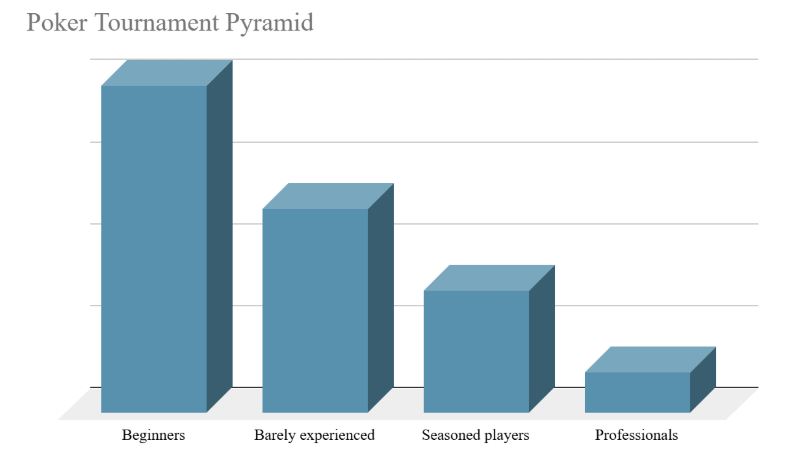
Once you get near the top, whether through satellites or with direct buy-ins, you’ll notice that tables take longer to fill. Many semi-pros spend hours at poker tables, but the pool is generally smaller. You may even begin remembering names and faces at this point. Studying your opponents is almost a prerequisite, and you can bet that they’ll be doing the same.
At the apex of the pyramid are the true professionals and world-recognised experts. These players rarely do anything else except play poker, and they’re heavily versed in all imaginable strategies and playstyles. Once you start participating in major tours, be prepared for anything, build your budget, and strive to advance through the rounds to get a taste for how different professionals play.
How Does Variance Impact Tournament Players? (Bankroll Management)
Variance refers to the unpredictable short-term swings in poker results, where you can play perfectly and still lose. In simple terms, it refers to the factors you can’t influence – your cards, community cards, and your opponent’s actions. Sure, you can exploit a vulnerability when it presents itself, but situations where your opponents have near-perfect defense (or you simply have worse cards) also factor into what variance means.
In tournaments, variance is even more brutal than in cash games because only a small percentage of the field gets paid, and most of the prize pool is weighted toward the top. Let’s illustrate this with an example.
Say you go all-in with pocket aces against pocket kings. You’re an 80% favourite, but the Kings hit a set. Another example may include you being forced out of a marginally good hand, say a pair of 10s, but the community cards end up being all faces, and your opponents finish with better scores.
Because of this, it’s generally advisable to prepare a budget that can cover at least 100-150 buy-ins for low-variance tournaments like Sit & Gos, or more than 200 buy-ins for large-field or re-buy multi-table formats.
Apart from budgeting, you should also focus on the Expected Value, rather than short-term profits. You don’t have to win every hand, but if you’re consistently making good value on your plays, even small profits can compound over time.
If you need more assistance with this matter, look up how to calculate poker tournament variance using dedicated tools or charts.
How Are Poker Tournaments Regulated in the UK? (Fairness and RNG)
Part 29 of the UKGC’s guidelines covers “Poker” as a broader gambling category. Chapter 2 of this segment is focused on casino-style poker gambling, with Clause 29.7 expressly mentioning poker competitions (tournaments).
To keep things fair and transparent, the UKGC requires all of its licensees to “bear full responsibility” for competitions that are either held in-house or involve third-party organisations.
Furthermore, some of the biggest poker tournaments in the UK and globally are run by independent, accredited RNG-testing organisations, such as eCOGRA or Gaming Labs International. These certificates prove that the poker software in question provides truly random outcomes and hasn’t been tampered with.
Responsible Gambling and Tournament Play
Self-control is even more important for poker tournament play than it is for standard gaming in casinos. Many players succumb to the pressure of big prizes, strong competition, and variance, which may tempt you to keep re-buying your chips more often than you can afford.
If you need more help managing your poker gambling budget, you can find valuable resources on these sites:
Conclusion: Mastering the Tournament Mindset
There’s far more depth to poker tournaments than ultra-large prize pools and shiny venues. The more time you spend at tournament tables, the more you’ll understand the impact of volatility, strategy, and advanced mathematical concepts behind rake, ICM, and M-Ratio.
This guide was meant to equip you with the knowledge that pros rely heavily on, but lived experience from played contests is irreplaceable. When you begin your journey, remember to gamble smartly and safely. Set a limit on how much money you’ll spend on tournaments daily, weekly, and monthly. Plan for re-buys to account for variance swings, but don’t go over the caps you’ve designed beforehand.